Marisela
The Shadow of the WindMarisela’s brief life in the story is known through a tale told by Bea about the origins of The Angel of Mist. She arrives in Barcelona as the longtime maid of Salvador Jausa, a wealthy Catalan financier returning from Cuba, and becomes the focus of scandal, a household catastrophe, and Jausa’s subsequent attempt to capture what he believes is her spirit on film. Yet nearly everything said about her is reported by other people: the society that condemns her, the police investigating the deaths, and Jausa, who insists she has returned as a presence in his house.
Arrival in Barcelona
Marisela travels with Jausa when he returns from the New World with his American wife and seven trunks. She has served him since his early years in Cuba, and the household initially stays in rooms at the Hotel Colon while Jausa looks for a residence suited to his ambitions. The story gives no account of Marisela’s own past or of how she understands her position; instead, it introduces her through the household she serves and the public stories told about her.
Barcelona’s upper-class observers assume that Marisela is Jausa’s lover and attribute to her influence over his private life. They also label her a witch and sorceress, turning her into a subject of gossip and moral suspicion. The account’s lurid details belong to those rumors, not to any testimony from Marisela herself. Her social presence is further made into a public spectacle when Jausa rides through the city with both his wife and Marisela. The contrast is sharp: Jausa can display his household openly, while Marisela is described through the judgmental gaze of a society that casts her as exotic and threatening.
The house and the deaths
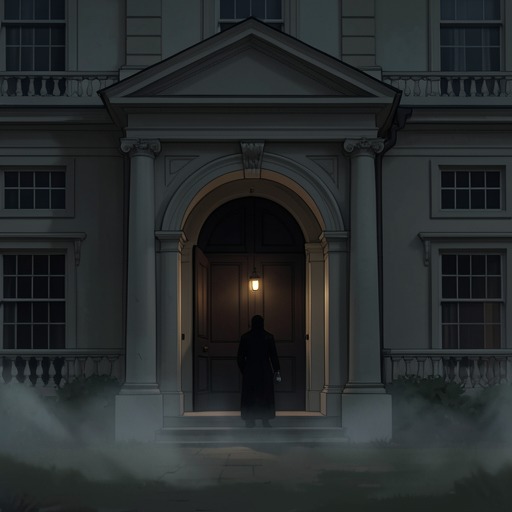
Jausa’s new home, built for him in 1899 in the still-isolated area of Avenida del Tibidabo, is intended to embody his distinctive tastes. Its garden is to contain angel statues arranged on a six-point star. After the family moves in during July 1900, a catastrophe follows within weeks: Jausa’s wife and Marisela are dead, and the police find Jausa alive but in a severely impaired condition. The house itself bears signs of the violence, including bloodstained walls, damaged angel statues, and traces of black candles.
The police conclude that Jausa and his wife were poisoned with a herbal substance found in Marisela’s rooms. They believe that Marisela killed herself after the deaths, leaving the house marked by the trail of her blood. The investigators propose jealousy as the motive and report that Jausa’s wife was pregnant. These are the police’s conclusions, not a confession or an account from Marisela; the narrative supplies no independent confirmation of what she intended or what happened inside the house. The case is eventually closed, while Jausa remains alive but loses his speech and hearing, becomes partly paralysed, and suffers lasting pain.
A haunting made into an experiment
After the investigation, Jausa refuses to leave the matter behind. He invites Don Ricardo Aldaya into the house and describes his project as a scientific and spiritual experiment. By then, Jausa believes Marisela remains there as a spirit, and says he can sense her presence. His servants flee, leaving him increasingly absorbed in the effort to make the invisible visible.
Jausa commissions the cinematographer Fructuós Gelabert to film the house’s corridors. The project takes on a particular logic because Jausa shares Marisela’s reported belief that a camera can swallow souls: film is meant to reveal what ordinary sight cannot. When a new low-light film stock is used, an accidental chemical reaction involving wine produces unusual shapes on the developed film. Jausa sees the forms as revenants, including what he identifies as Marisela’s silhouette beneath a shroud, changing into a wolf and walking upright. Aldaya sees only stains and doubts the results, so the images establish no objective proof that Marisela’s ghost exists.
Marisela’s afterlife in the story
The stories about Marisela continue after her death, but they remain divided between competing interpretations. Jausa treats her as a presence that can be encountered and recorded; the police account presents her as the suspected killer who died by suicide; later rumors say that she returned to take Jausa with her. The narrative does not resolve these claims. Instead, her absence becomes the source of Jausa’s fixation and part of the house’s fearful reputation.
Marisela’s significance rests partly in this gap between a person and the stories imposed on her. She is given no direct voice in the surviving account, while her alleged actions and supernatural return are narrated by people with their own interests or limited knowledge. The house preserves that uncertainty: it begins as Jausa’s extravagant project, becomes the scene of deaths and investigation, and is then repurposed as a supposed instrument for recovering Marisela’s presence. Her remembered image is therefore inseparable from the unequal gaze that first made her a scandal and from Jausa’s later need to believe that she had not entirely vanished.